
Who are Scouts?
Scouts are a go-getting group of young people aged 10 ½ to 14 who:
- Master new skills and try new things
- Make new friends
- Have fun and go on adventures, at home and abroad
- Explore the world around them
- Help others and make a difference, in their own communities and beyond
Week in and week out, they gather in groups called Scout Troops to conquer the small task of changing the world.
What do Scouts get up to?
Discovering the world
Being a Scout is all about discovering the world on your own terms and making the most of what you have, wherever and whoever you are.
Alongside your new friends, you’ll master the skills that’ll help you weather the storms of life, and try things you’d never get the chance to do at home or at school – working with trained volunteers to achieve whatever you set your mind to.
Starting small, thinking big
Scouts start small but think big. They stand up for what they believe in and make a difference on their doorstops, confident in the knowledge that their daily actions add up.
In a society that can often feel increasingly isolated and inward facing, Scouts build bridges and break barriers.
Throughout history, they’ve played all sorts of useful roles in society, and this legacy continues today.
Listening in, lending a hand
Scouts seek out the answers to the big questions, and to the smaller questions that don’t seem to matter but really should. Most importantly, they say yes more often than they say no – whether they’re taking part in their first ever camp away from home, writing their first line of code, or accepting the last of the toasted marshmallows.
Who leads Scouts?
Our pack is led by an adult Scout leader and other adults. All the adults are on hand to supervise activities, share their skills and keep everyone safe. All leaders are called by their first name.
Within our Troop, Scouts are part of a Patrol – smaller groups of Scouts who look out for one another, and help each other grow. Scouts usually gather in their Patrols at the beginning and end of meetings. They might also stick together on expeditions or trips away, or during certain activities..
Investiture and Promise
It’s important that everyone has the chance to think about their Promise and understand what it means, before they make it. You make your Promise for the first time during a special ceremony we call an Investiture, and your Promise can be renewed at any time.
An Investiture is a special celebration where someone is welcomed to Scouts, makes their Scout Promise, receives their Scout scarf. Making your Promise means you become a member 12th Chichester Scouts, as well as the worldwide Scout family.
Investitures are important and special ceremonies, but this doesn’t mean they have to be strict or scary!
The Scout Promise
Scouts choose the promise that best suits them.
Atheist or of no faith background
Atheist or of no faith background
On my honour,
I promise that I will do my best
to uphold our Scout values, to do my duty to The King,
to help other people
and to keep the Scout Law.
Buddhist
Buddhist
On my honour,
I promise that I will do my best
to seek refuge in the Triple Gem, to do my duty to The King,
to act with compassion towards all life
and to keep the Scout Law.
Christian
Christian
On my honour,
I promise that I will do my best
to do my duty to God and to The King,
to help other people
and to keep the Scout Law.
Hindu
Hindu
On my honour,
I promise that I will do my best
to follow my dharma and do my duty to The King,
to act with compassion towards all life
and to keep the Scout Law.
Humanist
Humanist
On my honour,
I promise that I will do my best
to uphold our Scout values, to do my duty to The King,
to help other people
and to keep the Scout Law.
Jewish
Jewish
On my honour,
I promise that I will do my best
to do my duty to God and to The King,
to help other people
and to keep the Scout Law.
Muslim
Muslim
In the name of Allah, the most beneficent and the most merciful,
I promise that I will do my best
to do my duty to Allah and then to The King,
to help other people
and to keep the Scout Law.
Sikh
Sikh
On my honour,
I promise that I will do my best
to do my duty to Waheguru and to The King,
to help other people
and to keep the Scout Law.
The Scout Law
- A Scout is to be trusted.
- A Scout is loyal.
- A Scout is friendly and considerate.
- A Scout belongs to the world-wide family of Scouts.
- A Scout has courage in all difficulties.
- A Scout makes good use of time and is careful of possessions and property.
- A Scout has self-respect and respect for others.
List of all the promises and the Scout law can be found here.
Uniform
If you are moving up from Cubs then you wear your Cub uniform until you get a Scout uniform. Otherwise as you’ll be taking part in lots of activities, you should just wear clothes you feel comfortable in.
Eventually, you’ll get your own Scout uniform to wear to meetings and camps. Wearing a uniform is comfy and practical. It means no one feels uncomfortable or left out and helps everyone to feel part of the Troop. It also gives you a place to show off all the badges you earn.
For Scouts at 12th Chichester, the uniform consists of a green shirt or blouse with your badges sewn on and a gold and blue coloured scarf, with the blue worn on the left. Uniform can be purchased from the official scout shop online, the district scout shop or there is usually some preloved uniform available to purchase via the Scout leaders.
We also have a Polo Shirt with the Group Logo can be purchased from Game, Set and Match – https://www.gsam.co.uk/collections/scouts-12th-chichester
Badges
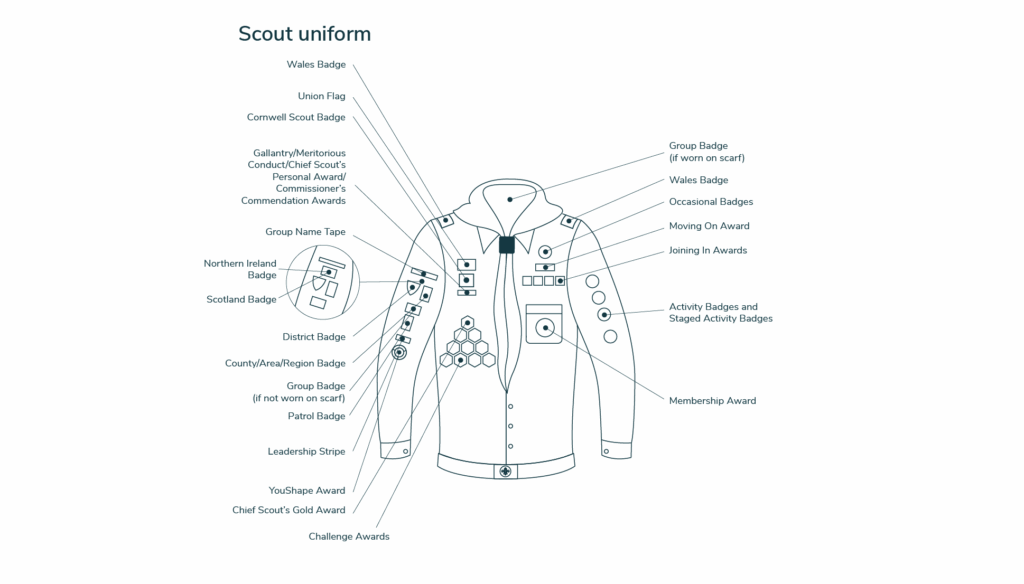
Scouts take part in many activities at troop meetings that work towards badges. Scouts can also earn badges in their own time. A list of all the current Scout badges can be found here. There are also challenge award badges and details about these can be found here. When a Scout is awarded a badge, it is needs sewing onto the uniform in the positions outlined below.
Our code of conduct
12th Chichester Scouts have formulated the following Code of Conduct to self police themselves at meetings. All the Scouts have signed a declaration to abide by this code during any Scout Meeting or Camp.
This Code of Conduct is a set of rules based around the Scout Promise and Scout Law and also the Government Initiative for Schools, Every Child Matters, that the Scouts and Leaders should follow in all aspects of life, both during and away from any specific Scouting activities. The intention is to ensure that everyone gets the most out of the planned meetings and all HAVE FUN.
- No Violence, No Swearing, No Bullying.
- Treat others the way you would like to be treated.
- Follow the whistle rules.
1 whistle means stop and listen to instructions.
3 whistles mean emergency stop what your doing, stand still and wait for instructions. - Respect personal space, social distancing and have awareness of others.
- Take care of scout HQ equipment and be careful with your own and others’ property.
- Be Kind.
- Wear the correct uniform according to the programme.
- Challenge yourself and others for scouting tasks.
- Support your patrol / team and carry out the task at hand.
- Help other people.
- Leaders and scouts are to listen to each other and respect the rules set out by the scouts and leaders.
- HAVE FUN!
As a group we have adopted the West Sussex Scouts behaviour police which can be found here: https://www.westsussexscouts.org.uk/youth-programme/west-sussex-behaviour-policy
How much does it cost?
There is a basic fee covering the cost of the upkeep of the head quarters and weekly meetings. Trips, camps and activities that take place away from the head quarters are usually charged separately.
Scouts is designed to be an accessible and affordable way for young people to learn lots of new skills through a single membership. Nobody should feel excluded from Scout activities because of money worries. If your parents/carers are concerned about costs, they should speak to their leader in confidence, to see what they can do to help. In most cases, support is available to make sure nobody misses out.